
Narendra Damodardas (Modi)
Introduction
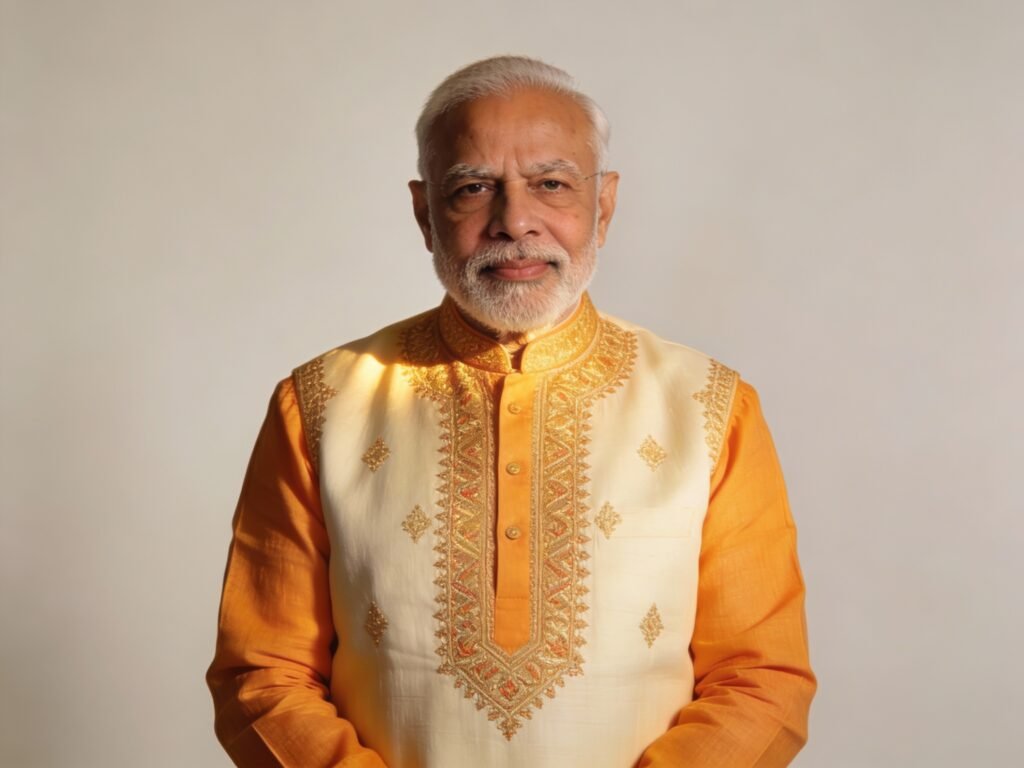
Narendra Modi is one of the most influential and controversial political leaders in contemporary India, serving as the country’s prime minister since 2014 and leading the Bharatiya Janata Party (BJP) to three consecutive terms in power. His journey from a modest childhood in Gujarat to becoming a global political figure is marked by strong Hindu nationalist ideology, aggressive economic and welfare reforms, and intense debates over democracy and minority rights.
Early life and Family Background
Narendra Damodardas Modi was born on 17 September 1950 in Vadnagar, a small town in Mehsana district of present-day Gujarat, into a family of Ghanchi oil-pressers classified as an Other Backward Class (OBC). His father, Damodardas Mulchand Modi, ran a tea stall near the railway station, and Modi has often recalled helping sell tea there during his childhood, becoming a symbol of his humble origins in political campaigns.
As a student, Modi was described as average in academics but active in debates, theatre, and the National Cadet Corps (NCC). Influenced by local leaders and the socio-political environment of post-independence India, he developed an early interest in nationalism and public life.
Association with RSS and Ideological Roots
In his teens, Modi became associated with the Rashtriya Swayamsevak Sangh (RSS), a right-wing Hindu nationalist volunteer organisation that would profoundly shape his worldview and political career. He formally joined as a pracharak (full-time worker), undergoing ideological training and organisational work that focused on discipline, self-reliance, and the idea of a culturally unified Hindu nation.
During this phase he travelled extensively, working at RSS offices, organising shakhas (local branches), and building grassroots contacts across Gujarat. This experience later helped him in booth-level election management, cadre mobilisation, and crafting a strong ideological base for the BJP in the state.
Education and personal life
Modi’s formal education has been a subject of political debate, but public records state that he received a Bachelor of Arts degree in political science from the University of Delhi and later a Master of Arts in political science from Gujarat University as an external student. These degrees date to the 1970s and 1980s, and although opposition parties have questioned details, universities have confirmed the basic credentials.
In his youth, Modi entered into an arranged marriage with Jashodaben, a woman from his community, but the relationship soon became estranged and he lived away from her, devoting himself to organisational work. He publicly acknowledged the marriage for the first time in 2014 when he filed his nomination papers for the Lok Sabha elections, listing her as his spouse as required by law.
Entry into BJP and rise in Gujarat
Modi formally joined the Bharatiya Janata Party in 1987, at a time when the party was still growing and experimenting with Hindutva-based mobilisation. He quickly rose through the ranks due to his skills in organisation, strategy, and communication, and played a key role in the BJP’s campaigns in Gujarat and other regions in the late 1980s and early 1990s.
By the mid‑1990s he became an important organisational leader in the Gujarat BJP, helping the party form governments and strengthening its base among urban middle classes, traders, and sections of OBCs. His reputation as an efficient organiser who could deliver electoral victories made him a natural choice when the party leadership decided to change the chief minister in 2001.
Chief Ministership of Gujarat (2001–2014)
Modi was appointed chief minister of Gujarat in October 2001, replacing Keshubhai Patel after criticism of the state government’s handling of an earthquake and governance issues. He contested his first direct election in 2002 and subsequently led the BJP to three consecutive victories in the Gujarat assembly, remaining in office until May 2014.
His tenure emphasised industrialisation, infrastructure, and investment through initiatives such as the Vibrant Gujarat summits, which showcased the state as a business-friendly destination. Supporters describe this as the “Gujarat model” that delivered high economic growth, reliable electricity, and improved roads, while critics argue that social indicators and human development did not improve proportionately for all communities.
The 2002 Gujarat riots and Controversy
Modi’s time as chief minister is inseparable from the 2002 Gujarat riots, which erupted after the burning of a train coach in Godhra that killed 59 Hindu pilgrims. In the communal violence that followed, more than a thousand people—most of them Muslims—were killed, and large-scale displacement and destruction of property took place.
Human rights organisations, opposition parties, and international observers accused the state government under Modi of failing to protect minorities and, in some accounts, of tacit complicity. Modi denied wrongdoing, and India’s Supreme Court–monitored investigations and cases did not find prosecutable evidence against him personally, but the episode continues to shape his polarising image in India and abroad.
National Profile and the Path to Delhi
Despite international criticism, Modi’s pro-business image and electoral success in Gujarat increased his popularity within the BJP and among a section of India’s middle class. He pitched himself as a strong, decisive leader who could deliver economic growth and better governance, contrasting himself with coalition-era instability and corruption scandals of previous governments.
By 2013 the BJP officially projected him as its prime ministerial candidate for the 2014 Lok Sabha elections, sidelining several older leaders and signalling a generational shift in the party. His campaign blended Hindutva symbolism, promises of development, and high-tech outreach using social media, 3D rallies, and targeted messaging to different voter groups.
Prime Ministerial Victory in 2014
In 2014 the BJP won a clear majority in the Lok Sabha, securing 282 seats on its own, while the National Democratic Alliance as a whole crossed 330 seats. This was the first time in three decades that a single party achieved an outright majority at the national level, and Modi was sworn in as India’s 14th prime minister on 26 May 2014.
The campaign’s core slogans like “Achhe Din Aane Wale Hain” (“Good days are coming”) promised job creation, economic revival, and a break from corruption-tainted politics. Modi’s personal brand dominated the election, overshadowing many local candidates and signalling the emergence of a highly centralised leadership style within the BJP.
Key Economic Reforms and Initiatives
Modi’s governments have pushed several major economic reforms and flagship schemes aimed at transforming India’s economy and governance. Among the most significant is the Goods and Services Tax (GST), launched in 2017, which replaced a complex web of indirect taxes with a unified structure across the country to simplify trade and improve compliance.
Another dramatic move was the 2016 demonetisation, which invalidated high‑value currency notes overnight with the stated goals of targeting black money, corruption, and counterfeit currency. While the policy expanded digital payments and formal banking, critics say it caused severe disruption to informal sectors and small businesses without clear evidence of long-term gains against black money.
Welfare and Social Sector Programmes
A central feature of Modi’s governance is large-scale welfare outreach, framed as serving the poor, women, and marginalised communities. Pradhan Mantri Jan Dhan Yojana opened hundreds of millions of bank accounts to promote financial inclusion, enabling direct benefit transfers and subsidies to reach beneficiaries more efficiently.
Flagship schemes include Swachh Bharat Mission to build toilets and end open defecation, Ujjwala Yojana to provide LPG connections to poor households, and Pradhan Mantri Awas Yojana for affordable housing in rural and urban areas. Data from government and party reports highlight figures such as over 12 crore toilets built, more than 10 crore LPG connections, and crores of homes and tap water connections delivered under various programmes.
Digital India and Startup Push
The Digital India initiative aims to expand broadband connectivity, digital infrastructure, and e-governance, encouraging digital payments and online delivery of government services. Unified Payments Interface (UPI)–based transactions have exploded, making India one of the world’s leaders in real-time digital payments, with even small vendors using QR codes.
The government has also promoted Start-up India and Stand-up India to boost entrepreneurship, claiming recognition of over 1.6 lakh startups and the creation of more than 17 lakh jobs in the ecosystem. Skill development schemes like PM Kaushal Vikas Yojana aim to train youth for jobs in emerging sectors.
Landmark Political and Constitutional Decisions
Modi’s second term after the 2019 elections saw several high-impact political and constitutional moves that reshaped India’s legal and territorial framework. On 5 August 2019, the government abrogated Article 370 and Article 35A, removing the special autonomous status of Jammu and Kashmir and reorganising it into two Union Territories—Jammu & Kashmir and Ladakh.
Another headline decision was the Citizenship Amendment Act (CAA) of December 2019, which offers a path to Indian citizenship for non‑Muslim migrants from Pakistan, Bangladesh, and Afghanistan who entered India before the end of 2014. Supporters see it as humanitarian protection for persecuted minorities, while opponents criticise it as discriminatory and fear its combination with a nationwide citizenship register could marginalise Muslims.
Ram Temple, Triple Talaq and Social Agenda
Modi’s tenure is closely linked to long-standing Hindutva demands such as the construction of a Ram temple in Ayodhya. After the Supreme Court’s 2019 verdict allowing a temple at the disputed site, his government facilitated the project, and the consecration ceremony became a major symbolic event for his supporters.
The government also passed legislation criminalising instant triple talaq, projecting it as a measure for Muslim women’s rights and gender justice. Critics argue that selective criminalisation and broader rhetoric around Muslims reflect an exclusionary agenda, while supporters say it ends a regressive practice and integrates Muslim women into broader legal protections.
Foreign Policy and Global Image
Modi has pursued an active foreign policy, positioning India as a rising power and voice of the Global South. Early in his tenure he focused on neighbourhood diplomacy, ties with the United States and Japan, and calibrated engagement with China, hosting leaders like Xi Jinping and participating in forums like BRICS and G20.
Under his leadership India strengthened its “Act East” policy, joined strategic groupings like the Quad with the US, Japan, and Australia, and promoted initiatives on climate, clean energy, and connectivity. Large public events with the Indian diaspora, such as rallies in the US and UK, and his high social media visibility have contributed to his image as a charismatic global statesman.
Third Term and recent Developments
In the 2019 elections the BJP expanded its majority, reinforcing Modi’s dominance over national politics and enabling more centralised decision-making. Despite economic headwinds and protests, his popularity remained high among large sections of voters who credit him with strong leadership and welfare delivery.
In the 2024 Lok Sabha elections the BJP fell short of a solo majority but, with allies in the National Democratic Alliance, secured enough seats for Modi to form a government for a third term, an achievement matched by few Indian leaders. His third term has continued to focus on welfare expansion, infrastructure, and a more assertive foreign policy, while debates about democratic health and social cohesion have intensified.
Public image and Personality cult
Modi’s public image is carefully crafted through oratory, symbolism, and mass communication. He hosts a monthly radio show “Mann Ki Baat” to directly address citizens, uses social media extensively, and frequently appears in highly visual events, from yoga on International Yoga Day to interactions with technology and cultural icons.
Supporters often portray him as a self‑made, incorruptible leader with a simple lifestyle, emphasising stories of his early struggles and disciplined routine. Critics describe the growing personality cult as unhealthy for democracy, arguing that it sidelines institutions, decentralisation, and internal party democracy in favour of a leader-centric model.
Criticism, Democratic concerns and Human Rights
International watchdogs and rights groups have raised concerns about democratic backsliding, media freedom, and minority rights under Modi’s rule. Reports highlight the use of sedition, anti-terror, and other laws against activists, journalists, and protesters, as well as restrictions or pressures on civil society organisations and foreign NGOs.
The government’s rhetoric and policies, along with speech by some BJP leaders, are seen by critics as fuelling majoritarian nationalism and normalising hostility toward Muslims and other minorities. Supporters counter that law-and-order measures and cultural assertiveness are necessary to protect national security, curb separatism, and correct what they see as past appeasement politics.
Economic challenges and debates
Despite high-profile reforms, India under Modi has faced persistent challenges of unemployment, underemployment, and agrarian distress. Economists have debated the impact of demonetisation, GST rollout, and Covid‑19 lockdowns on small businesses, informal workers, and overall growth trajectories.
The government highlights macro indicators such as rising foreign investment, improved Ease of Doing Business rankings, increased infrastructure spending, and a boom in digital and startup sectors as proof of structural transformation. Critics emphasise inequality, jobless growth concerns, and the need for stronger investment in health, education, and labour‑intensive manufacturing.
Awards, Honours and International Recognition
Modi has received several international honours from foreign governments and organisations, reflecting both diplomatic ties and his global profile. These include awards from countries in the Gulf, Russia, and others, often cited by his supporters as recognition of his leadership and India’s rising status.
He has also authored or lent his name to books such as “Exam Warriors,” aimed at students, and collections of poetry and reflections in Gujarati. Domestically, his high approval ratings in various opinion polls and repeated electoral victories reinforce his image as one of the most dominant Indian politicians of the post‑independence era.
Conclusion: A Polarising era in Indian Politics
Narendra Modi’s story is that of a leader who transformed Indian politics through a blend of welfare expansion, digital and economic reforms, assertive nationalism, and powerful personal branding. For millions of supporters he embodies strong leadership, development, and cultural confidence, while for many critics he represents rising majoritarianism, weakened institutions, and shrinking space for dissent.
As Modi continues his third term in office, India’s trajectory under his leadership remains central to debates about the country’s democracy, economy, and identity in the twenty‑first century. How history ultimately judges his era will depend on long-term outcomes in social harmony, inclusive growth, and the resilience of India’s democratic institutions.